Contact CE/Grad
- 617-333-2364
- ccce@curry.edu
- Milton Campus

As a practicing professional, you are well aware of the dynamic changes in our highly complex healthcare system that require you to think differently about how you care for patients. You need to do more than understand a diagnosis and implement a treatment plan. You're expected to be a straightforward communicator, a thoughtful leader, an effective educator, a strong advocate for your patients and community, a contributing member of a healthcare team and much more.
Who Should Apply?
The MSN Nursing Administration Concentration was designed for you if you:
- Are a registered nurse with a valid Massachusetts RN license
- Have a bachelor's degree in any field
- Seek to advance in your nursing career as an Administrator
Do you have a non-Nursing Bachelor's Degree?
Curry College offers a Pathway to MSN for Registered Nurses with a non-Nursing Bachelor's Degree.
MSN (Administration) Program Information
Join us to learn more about degree and non-degree programs and classes available through the Division of Continuing and Graduate Studies.
Associate of Science in Nursing (ASN, LPN-RN)
Friday, May 8 @ 3:30 p.m. - Register
Thursday, May 14 @ 12:00 p.m. - Register
Accelerated Bachelor's in Nursing (ACCEL) & Accelerated Entry Master's in Nursing (AE-MSN)
ACCEL or AE-MSN: Which Program is Right for You?
Tuesday, May 26 @ 5:00 p.m. - Register
Connect with an Advisor
There's no need to wait for us to schedule an information session. Our knowledgeable advisors are available to meet with you via Zoom or phone to answer your questions. Get started on your way to earning your degree!
Schedule a one-on-one appointment now
Or even better, connect with an advisor by calling 617-333-2364.
A Rigorous Curriculum
The 35-credit program is comprised of the following 12 courses:
| MSN 6200 | Advanced Pathophysiology | 3 |
| MSN 6000 | Advanced Assessment and Clinical Reasoning | 3 |
| MSN 6600 | Informatics and Health Management Systems | 3 |
| MSN 6300 | Nursing Science and Evidence-based Practice | 3 |
| MSN 6500 | Advanced Pharmacology | 3 |
| MSN 6040 | Advanced Evidence-Based Research and Statistical Analysis |
3 |
| MSN 6470 | Organizational Leadership in Health Care | 3 |
| MSN 6770 | Quality Improvement Science and Risk Management in Health Care |
3 |
| MSN 6450 | Health Policy, Systems and Financing | 3 |
| MSN 7982 | Capstone Seminar | 2 |
| MSN 7873 | Practicum in Nursing Administration (130 hours) |
3 |
| MSN 6100 | Leadership | 3 |
Courses are offered in a hybrid format combining in-class and online learning activities. Our Hyflex format provides choice around when to attend in-person or online, even changing your mind from week to week.
The MSN is a full-time program. You learn in a cohort group, meaning that the same students will be in all of your classes for the entire program from start to finish.
Next Cohort:
Spring 2026 - Milton Campus: Thursday Evenings, 5:30 – 8:30 p.m.
The baccalaureate degree program in nursing and master's degree program in nursing at Curry College are accredited by the Commission on Collegiate Nursing Education, 655 K Street, NW, Suite 750, Washington, DC 20001, 202-887-6791.
Curry College MSN Program Outcomes:
- Translate theory and evidence from a multidisciplinary perspective to inform advanced nursing practice, education, and research.
- Design care environments which promote a holistic and personalized delivery approach driven by outcome data.
- Evaluate the effectiveness of population-based interventions with the goal of improving the health of diverse populations to reduce health inequities.
- Disseminate best practice strategies into practice settings to promote innovation and ethical decision making.
- Lead safety and quality initiatives guided by established benchmarks and performance metrics, to achieve optimal health outcomes.
- Leverage expertise to foster collaboration among care teams to optimize care delivery and coordination.
- Formulate systems-based approaches to address complex health system issues, using frameworks consistent with fiscal responsibility and appropriate resource allocation.
- Appraise the intersection between healthcare technologies, information, and communication and its impact on care delivery.
- Model a continuously evolving professional identity through deliberate contribution to the nursing discipline.
- Foster a culture committed to personal and professional growth, leadership development, and healthy work environments.

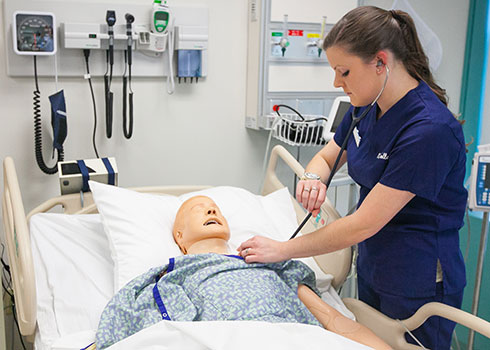
Accredited Programs. A Tradition of Excellence.
The baccalaureate degree in nursing program and master's degree in nursing program at Curry College are accredited by the Commission on Collegiate Nursing Education, 655 K Street NW, Suite 750, Washington DC 20001, 202-887-6791.